Watch the Full Video
Episode Summary
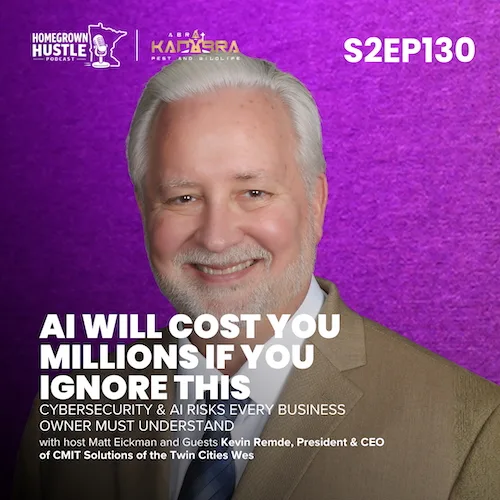
In this high-level, systems-oriented conversation, host Matt Eickman sits down with Kevin Remde, President & CEO of CMIT Solutions of the Twin Cities West, to unpack the rapidly evolving intersection of cybersecurity, artificial intelligence, and operational infrastructure for small-to-mid-sized businesses. Drawing from decades of experience—including Remde’s tenure as a Microsoft technical evangelist—the episode reframes IT not as a cost center, but as a mission-critical risk management and growth lever.
The discussion moves beyond surface-level tech talk into applied strategic frameworks: the hidden dangers of “shadow IT,” the systemic vulnerabilities created by poor patch management, and the economic implications of cybersecurity negligence. Remde introduces a pragmatic blueprint for AI adoption—balancing innovation with governance—while emphasizing the compounding risks of unmanaged data exposure in large language models.
From ransomware economics and insurance denial rates to the psychology of business owner complacency, this episode delivers a sobering yet actionable thesis: in a world where data is the primary asset, proactive security architecture is not optional—it is existential.
Key Takeaways:
- AI adoption without governance creates data leakage risks, especially when using free large language models
- “Shadow IT” is a growing threat—employees independently deploying tools without oversight can expose sensitive data
- Patch management is one of the most overlooked yet critical cybersecurity defenses
- Reactive IT (fixing problems after failure) is exponentially more expensive than proactive management
- A significant percentage of small businesses fail after major cyberattacks due to recovery costs
- 40% of cybersecurity insurance claims are denied due to inaccurate or non-compliant security practices
- Password reuse remains one of the easiest ways for attackers to gain access across multiple systems
- AI hallucinations still exist—outputs must be validated before execution, especially in technical workflows
- Businesses should formalize AI adoption through structured internal programs and shared learning systems
- Cloud migration (e.g., SharePoint, Teams, OneDrive) increases flexibility—but requires independent backup strategies
- The future of AI in business is not replacement—but augmentation of human productivity and decision-making
- Competitive advantage will favor businesses that adopt AI early and integrate it into workflows effectively
Chapters:
00:00 – 01:00 | Introduction: Why This Conversation Should Scare You
01:00 – 03:30 | What a Managed Service Provider Actually Does
03:30 – 05:30 | Real-World Cyberattack Stories (Phishing & Financial Loss)
05:30 – 07:30 | AI Risks: Shadow IT & Data Exposure in LLMs
07:30 – 09:30 | Cybersecurity Fundamentals: Patching, Monitoring, EDR
09:30 – 12:00 | The True Cost of Ignoring IT Infrastructure
12:00 – 15:00 | Ransomware Economics & Insurance Claim Denials
15:00 – 17:30 | Bridging the Knowledge Gap for Business Owners
17:30 – 20:30 | Cloud Migration Case Study (Server → Microsoft 365)
20:30 – 23:00 | AI Use Cases: Marketing, Sales, and Workflow Automation
23:00 – 26:00 | Building AI Systems vs. Wasting Time on Tools
26:00 – 29:00 | The “All-in-One AI Stack” & Training Infrastructure
29:00 – 31:30 | AI Hallucinations & Trust Boundaries
31:30 – 33:30 | The Future of AI in Business Operations
33:30 – 35:30 | Will AI Reduce Costs or Increase Margins?
35:30 – 37:30 | Password Security & Credential Risks
37:30 – 39:00 | Privacy Tradeoffs & Data Ownership
39:00 – 41:00 | What “Hustle” Means in a Rapidly Changing Tech World
GUEST RESOURCES:
Website: https://www.cmitsolutions.com/twin-cities-west
Facebook: https://www.facebook.com/CMITTCNW/