Watch the Full Video
Episode Summary
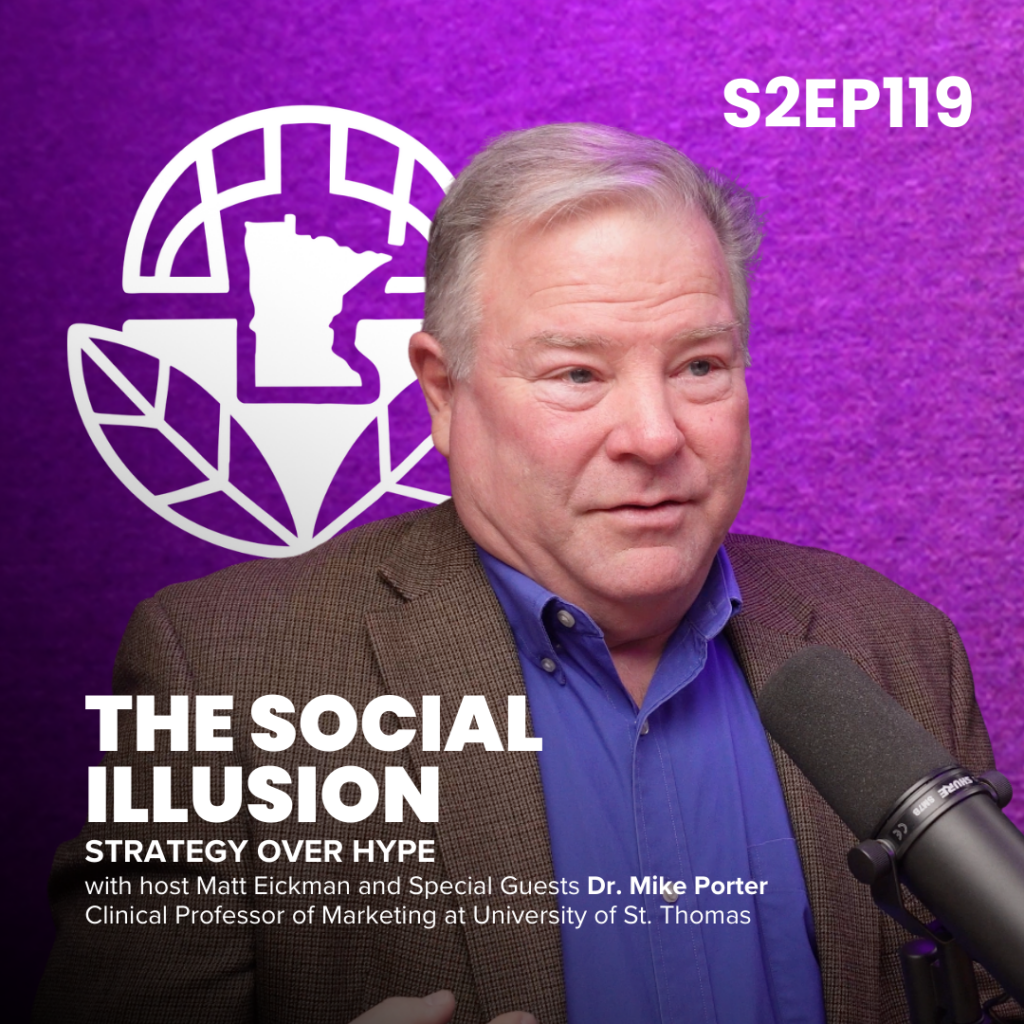
In this PhD-level masterclass on modern marketing communications, Dr. Mike Porter, Clinical Professor of Marketing at the University of St. Thomas, joins host Matt Eickman to deconstruct the strategic realities behind social media. Moving beyond surface-level tactics, Dr. Porter reframes social media within the PESO model (Paid, Earned, Shared, Owned) and challenges entrepreneurs to rethink how awareness, persuasion, and conversion truly function.
This episode explores the psychological architecture of communication, the economics of attention, generational segmentation, voice consistency, authenticity, influencer dynamics, reputation management, competitor response strategy, and the difference between tactical noise and strategic intent.
For entrepreneurs who feel pressured to “be everywhere” on social, this conversation provides clarity: social media is not the destination — it is a conduit. The objective is not virality. The objective is movement — from awareness to belief to action — within a system you control.
Key Takeaways:
- The PESO Model (Paid, Earned, Shared, Owned) provides a strategic framework for placing social media in context — and social should ultimately drive to owned assets.
- Social media is shared space, not controlled space. You control what you post — not how others respond.
- Not every business needs every platform. Start with your audience, not the algorithm.
- Messaging must evolve across segments, but voice must remain consistent.
- Authenticity outperforms polish. A genuine imperfect message to the right audience beats a perfect message to the wrong one.
- Awareness → Opinion → Belief → Action is the persuasion pathway. Social typically operates in the awareness and early persuasion stages.
- You cannot fully educate in one social post — use social as a bridge to deeper owned content.
- There is a strategic difference between doing nothing and choosing to do nothing.
- Anticipate competitor response and detractors before entering a conversation.
- Businesses can separate brand promotion content from industry reputation-building content.
- Analytics are accessible — but business owners don’t have to master them personally. Leverage young talent or strategic partnerships.
- Perfection is not required. Alignment is.
Chapters:
00:00 – Introduction: Why Social Media Isn’t What You Think It Is
01:17 – The PESO Model Explained (Paid, Earned, Shared, Owned)
04:00 – Audience First: Platform Choice as a Strategic Decision
06:45 – Messaging Across Segments Without Losing Brand Voice
09:52 – Authenticity vs. Artifice in Social Communication
14:03 – Large Companies & The Authenticity Dilemma
16:10 – The Awareness → Belief → Purchase Continuum
20:29 – Competitors, Detractors & Strategic Response Planning
23:20 – Education vs. Entertainment in Social Media
26:01 – Journalism, Bias & Credibility in the Digital Age
27:23 – Building Industry Reputation Alongside Brand Reputation
30:01 – Tactical Questions vs. Strategic Thinking
31:31 – Analytics for Entrepreneurs: Start Small, Think Smart
33:44 – Final Thoughts: Alignment Over Perfection
Guest Resources:
Linkedin: https://www.linkedin.com/in/dr-mike-porter-apr-fellow-prsa-he-him-2a033/
Website: https://researchonline.stthomas.edu/esploro/profile/mike_porter/overview